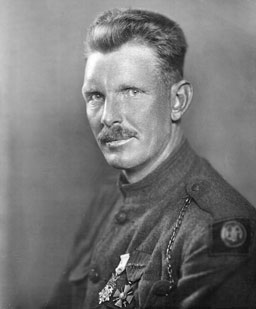
Alvin C. York – World War I – US Army
CITATION:
After his platoon had suffered heavy casualties and three other noncommissioned officers had become casualties, Cpl. York assumed command. Fearlessly leading seven men, he charged with great daring a machine-gun nest which was pouring deadly and incessant fire upon his platoon. In his heroic feat the machine-gun nest was taken, together with four officers and 128 men and several guns.
ADDITIONAL INFORMATION:
World War I, often referred to as the Great War, was a global conflict that lasted from 1914 to 1918 and fundamentally reshaped the political and social landscape of the twentieth century. Originating in Europe, the war was triggered by the assassination of Archduke Franz Ferdinand of Austria-Hungary, but its underlying causes were far more complex, including militarism, alliance systems, imperial competition, and nationalist tensions among European powers. The conflict quickly expanded beyond a regional dispute into a global war involving the Allied Powers—primarily France, Great Britain, Russia, and later the United States—and the Central Powers, led by Germany, Austria-Hungary, and the Ottoman Empire.
A defining characteristic of World War I was the emergence of industrialized warfare. Technological advancements such as machine guns, heavy artillery, chemical weapons, and trench fortifications produced unprecedented levels of destruction and stalemate, particularly along the Western Front. The war of attrition resulted in massive casualties, with millions of soldiers and civilians killed or wounded, and entire regions devastated. The Eastern Front and other theaters, including the Middle East and Africa, further expanded the scope of the conflict.
The entry of the United States in 1917 provided a critical boost to Allied forces, contributing to the eventual defeat of the Central Powers in 1918. The war concluded with the signing of the Treaty of Versailles in 1919, which imposed significant territorial, military, and financial penalties on Germany. While intended to secure lasting peace, the treaty’s terms fostered economic hardship and political instability, laying the groundwork for future conflict.
World War I marked the collapse of several empires, including the Austro-Hungarian, Ottoman, Russian, and German empires, and led to the redrawing of national boundaries. It also accelerated social change, including shifts in gender roles and the role of the state in economic life, leaving a lasting legacy on global affairs.